Hotel breakfast rooms: how to improve atmosphere, space, and perceived value
Index:
- Why the warmer months change the perception of the breakfast room
- Signs that indicate an unbalanced breakfast room
- How to use space and height to make the buffet lighter
- The role of equipment in the visual balance of the room
- Continuity between inside and outside: why it really matters
- What to check before the high season
- Why atmosphere affects the perception of value
With the arrival of summer, many hotels focus their attention on operational aspects such as seating capacity, flow management, or updating their offerings. These are all important elements, but there are some one that is often overlooked: the atmosphere of the breakfast room.
Often the The breakfast room remains the same in the building for months.The layout of the buffet does not change, the heights remain the same, the concentration of the elements is unchanged. However, with the change of season, the way guests perceive the space changesNatural light changes, the pace of life changes, the relationship between the internal and external environment changes. Consequently, a space that at another time of the year might have been functional can suddenly appear heavier, less harmonious or simply less welcoming.
For this reason, before the season really gets into full swing, It is useful to evaluate the breakfast room not only from a practical point of view, but also from a perceptual one.
Why the warmer months change the perception of the breakfast room
During the brightest months, hotel spaces are observed with a different attention. The breakfast room, in particular, It is one of the environments where seasonal change is most noticeable, because it brings together light, movement, moments of sociality and organisation of the buffet.
Natural light changes visual balance
When natural light increases, every element of the breakfast room becomes more evident. Surfaces, materials, finishes, colours and volumes acquire greater presenceThis means that even small imbalances, which at other times of the year go unnoticed, become more noticeable.
Un too compact buffet, too rigid a layout or an excessive presence of equipment they can appear heavier precisely because the light highlights them. At the same time, a well-organized space appears tidier, more open, and more coherent.
Guests' behaviors are also changing
With the warm weather, guests move differently. The breakfast times can be more relaxed, the most dynamic flows, a more marked focus on airy and bright environmentsIf the breakfast room doesn't embrace this change, the experience risks feeling less natural.
For this reason, it is not enough that the room is functional. Must also be able to convey a feeling of lightness and well-being, in line with the time of year and the expectations of those staying at the property.
For this reason, you need to rely on qualified partners like Yegam. With our consultancy, we help you improve your guests' experience.
Signs that indicate an unbalanced breakfast room
An ineffective breakfast room does not always present obvious problems. In many cases it works on an operational level, but However, it still conveys a feeling of heaviness or disorderRecognizing the signs is the first step to understanding where to intervene.
Too many elements concentrated in the same spot
One of the most frequent problems are the excessive concentration of objects on the buffet. When every product, accessory or support is placed on the same surface without any real hierarchy, the result can be visually saturated.
This density does not help the guest. On the contrary, makes it more difficult to read the offer, identify its key points and move naturallyA well-constructed buffet should draw the eye, not tire it.
Uniformity in pitches and lack of rhythm
When everything develops on the same level, the buffet loses dynamismPlates, trays, containers, coffee items, and accessories are aligned too uniformly, creating a continuous, compact visual band.
This effect flattens the whole and reduces the feeling of order.. On the contrary, a correct use of heights allows you to create rhythm and better enhance the products and lighten the composition.
Unclear flows and sluggish movements
Un another aspect to observe concerns the guests' pathsIf people cross paths in a disorderly manner, if there are congestion points or if the buffet forces you to make unintuitive movements, the general perception of the room worsens.
The efficiency of a breakfast room is also measured by its ease of use. When the layout accommodates movement, everything appears simpler, smoother, and more professional.
How to use space and height to make the buffet lighter
In breakfast room design or overhaul work, one of the central themes is the relationship between available space and distribution of elementsIt's not just how many products or equipment are present that matters, but how they are inserted into space.
Heights help build hierarchy
Differentiating the levels means better organizing the reading of the buffetHeights allow you to create focal points, separate functions, highlight certain products, and distribute visual weight more evenly.
This approach improves both aesthetics and functionality. Guests perceive greater order and can more readily locate what they're looking for. The buffet, in turn, appears more refined and less crowded.
Even empty space has a function
A common mistake is to think that an empty surface is wasted space. In reality, in hospitality settings, emptiness is a design tool. It serves to provide space, visually separate elements, and improve the overall clarity.
Leaving space where needed doesn't mean depleting the offerings, but enhancing them. A buffet that breathes conveys greater control, greater elegance, and a higher perceived quality.
Less overlap, more clarity
When there are too many functions and too close together, the breakfast room becomes more difficult to interpret. Separating areas, better distributing elements, and reducing overlap helps improve the experience.
This is especially true during busy times. A more clearly arranged buffet is also quicker to use, easier to manage, and more effective in its presentation.

The role of equipment in the visual balance of the room
Buffet tables are often chosen to meet immediate practical needs, but their impact extends beyond function. Each element contributes to defining the character of the breakfast room.
Equipment communicates order or confusion
Stands, cake stands, dispensers, coffee accessories, tableware, and containers are never neutral. If selected without an overall vision, they risk creating fragmentation. Different shapes, inconsistent materials, and incorrect proportions create visual discontinuity.
When the equipment interacts with each other, the result is more harmonious. The room appears better organized, and even the buffet takes on a more professional appearance.
Functionality and aesthetics must work together
In the hotel industry, it's not enough for equipment to be convenient to use. It must also fit properly into its surroundings. This means considering its size, materials, finishes, dimensions, and relationship with other existing elements.
An effective solution is one that simplifies service without compromising the visual lightness of the space. When function and aesthetics work together, the buffet is more in keeping with the standard of the establishment.
The final effect affects the perceived value
Guests don't technically analyze the quality of the equipment, but they immediately perceive its overall effect. A disorganized arrangement conveys less attention to detail. A coordinated arrangement, on the other hand, conveys the idea of a thoughtful, cared for, and reliable space.
And it is precisely at this point that the breakfast room ceases to be just a service area and becomes part of the hotel's identity.
Continuity between inside and outside: why it really matters
When the warmer weather arrives, the breakfast room can't be considered merely an enclosed space. Even without major structural changes, the connection with the outdoors becomes more important and visible.
The perception of space also depends on the context
The presence of light, openings, windows, glimpses of the outside, or simply increased brightness influences the way the room is experienced. If the buffet appears too heavy or visually disconnected from the surrounding environment, the overall effect is lost.
Conversely, when there is continuity between internal and external space, the breakfast room appears larger and more pleasant.
Materials and volumes must interact with the season
Continuity is also achieved through materials, colors, and proportions. Elements that are too bulky or visually closed can be out of place at a time when guests are seeking more open and relaxed spaces.
A coherent choice of surfaces, equipment, and volumes helps make the space more contemporary and more in line with the seasonal context.
A more airy environment improves the experience
The idea of lightness isn't just about aesthetics. It impacts overall comfort. A space perceived as airy puts guests at ease, makes their stay more pleasant, and reinforces positive memories of the experience.
For this reason, the continuity between interior and exterior is not a secondary detail, but a concrete lever of perceived quality.
What to check before the high season
Before the busiest period begins, it's a good idea to take a more strategic look at the breakfast room. Even small adjustments can significantly improve the way the space is perceived.
Check if space really breathes
The first question to ask is simple: does the breakfast room appear light or too crowded? Looking at the space from this perspective allows you to immediately identify any excesses, unnecessary concentrations, or visual imbalances.
Very often, the problem is not the quantity of elements present, but their distribution.
Evaluate heights, equipment and routes
Effective control should address at least three aspects: height adjustments, equipment consistency, and fluidity of movement. If any one of these elements isn't working, the entire room suffers.
A well-organized buffet should be legible, tidy, and convenient to use. If any of these qualities are missing, the space likely needs an overhaul.
Intervene before the problem becomes evident
The best time to perform an inspection is before peak season, not during. Early intervention allows you to adjust the layout, improve the visual impact, and address peak periods with a more effective space.
In many cases, radical changes aren't necessary. A more careful reinterpretation of the space, a better selection of existing items, and a more coherent buffet design are all that's needed.
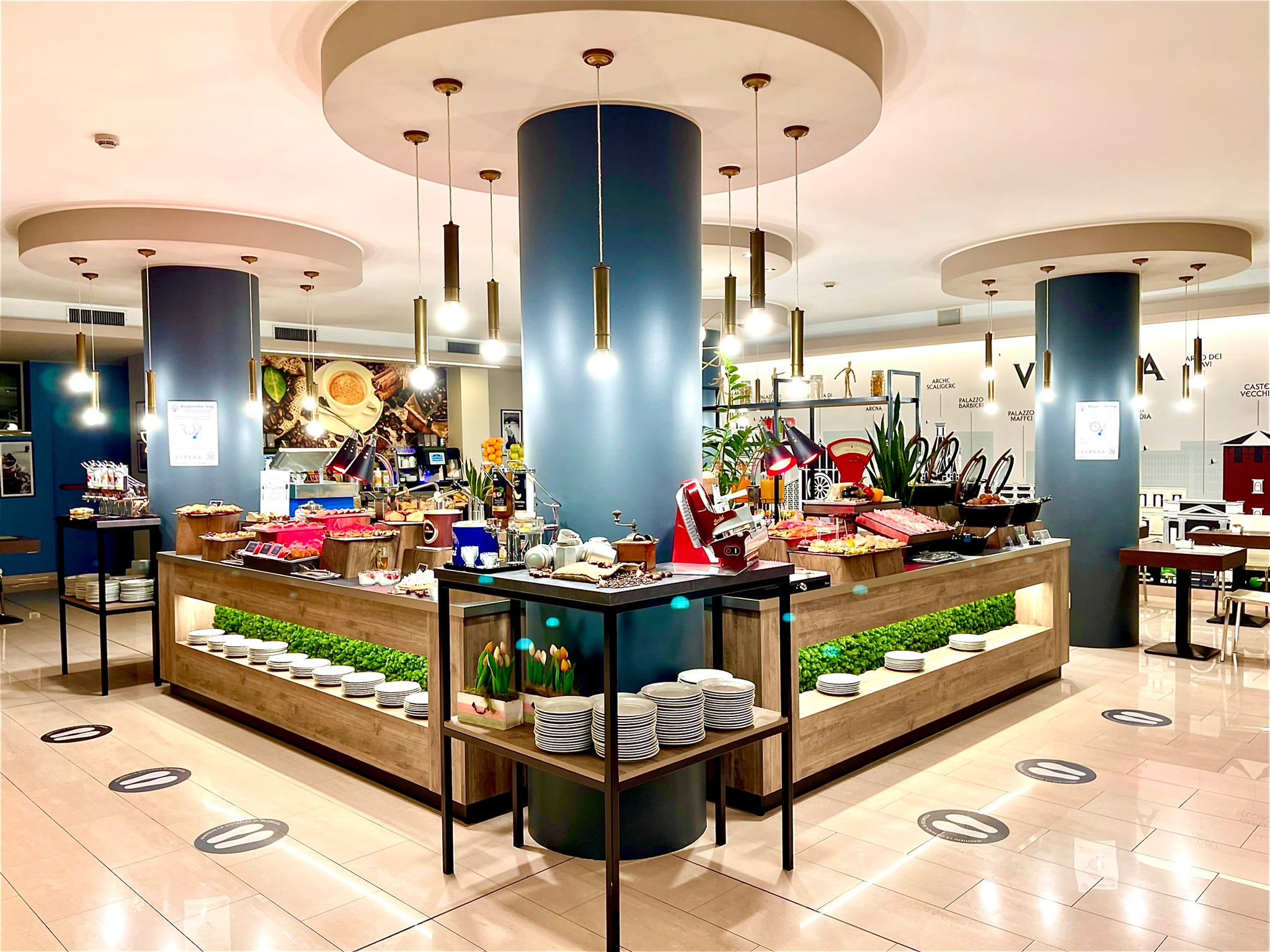
Why atmosphere affects the perception of value
The breakfast room is one of the places where guests come into closest contact with the true quality of the establishment. Here, quality is evident not only in the products, but in how they are presented, organized, and placed within the space.
The guest perceives the balance even before the detail
Those who enter a breakfast room don't analyze each component individually. They immediately perceive the whole. They understand whether the space is tidy, whether there is coherence, whether the buffet appears pleasant and easy to enjoy.
This initial impression has a very strong weight, because it conditions the perception of the service as a whole.
A well-designed space strengthens the hotel's identity
When the breakfast room is thoughtfully designed, it conveys attention to detail, professionalism, and a sense of coherence with the hotel's positioning. This strengthens the hotel's identity and enhances its perceived quality.
Conversely, an unbalanced space can weaken even a valid offering.
Doing a check today means valuing more tomorrow
Before the season kicks off, taking a moment to evaluate the atmosphere, space, materials, and tools can make a real difference. It's not just about improving the breakfast room's aesthetics, but also about making it more consistent with the value the hotel wants to convey.
Atmosphere isn't created by decorative details. It's created by the balance between space, materials, and tools. And it's precisely this balance that influences the perception of value.